
In stock
 Pay over 3 EQUAL zero-interest instalments of R4,00 with PayJustNow.
Find out how...

HOW IT WORKS
PayJustNow allows you to pay for your purchase over 3 payments with 0% interest and no fees. Pay a third at checkout and receive your goods immediately. The remaining two instalments are debited on your selected instalment dates.
Browse online or in-store and proceed to checkout

Choose PayJustNow as your payment method

Create your account and receive an instant approval decision
Complete your transaction
WHAT YOU WILL NEED
Be over 18 years old
Be a South African resident
Have a debit or credit card
Have a valid email address
0% INTEREST. 3 PAYMENTS. NO STRESS.
WHY PAY ANY OTHER WAY?
In stock
Pay over 3 EQUAL zero-interest instalments of R4,00 with PayJustNow.
Find out how...
HOW IT WORKS
PayJustNow allows you to pay for your purchase over 3 payments with 0% interest and no fees. Pay a third at checkout and receive your goods immediately. The remaining two instalments are debited on your selected instalment dates.
Browse online or in-store and proceed to checkout
Choose PayJustNow as your payment method
Create your account and receive an instant approval decision
Complete your transaction
WHAT YOU WILL NEED
Be over 18 years old
Be a South African resident
Have a debit or credit card
Have a valid email address
0% INTEREST. 3 PAYMENTS. NO STRESS.
WHY PAY ANY OTHER WAY?
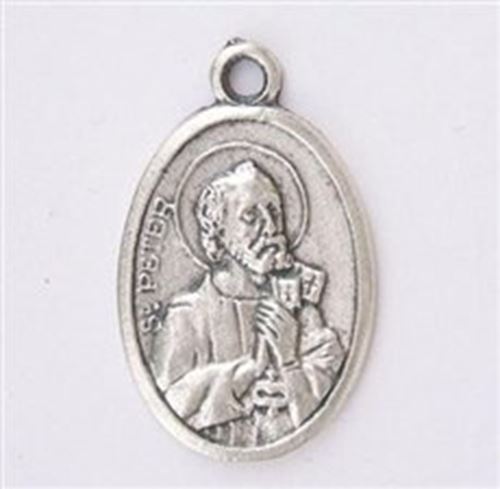
St Peter medal – first Pope
This medal features an image of St. Peter.
Made in Italy, silver oxidized and is approximately 2.5cm or 7/8″ tall.
Attached jump rings are included.

|
Saint Peter |
|
|---|---|
|
Apostle, Pope, Christian martyr and preacher |
|

|
|
| Church |
Catholic Church |
| Papacy began | AD 30 |
| Papacy ended | AD 64 or 67 |
| Predecessor | New creation (First Pope) |
| Successor |
Linus |
| Orders | |
| Ordination |
by Jesus Christ (First Bishop) |
| Personal details | |
| Birth name | Shimon or Simeon (Simon) |
| Born |
Unknown date Bethsaida , Gaulanitis , Syria |
| Died |
c. AD 64 or 67 [ 1 ] Clementine Chapel , Vatican Hill , Rome , Italia , Roman Empire |
| Parents | Jonah or John |
| Occupation | Fisherman, apostle |
| Sainthood | |
| Feast day |
Main feast (with Paul of Tarsus ) 29 June ( Catholic Church , Eastern Orthodox Church , Oriental Orthodoxy , Anglicanism , Lutheranism ) Chair of St Peter in Rome 18 January (Pre-1960 Roman Calendar) Confession of St Peter 18 January (Anglicanism) Chair of St Peter 22 February (Roman Catholic Church) St Peter in Chains 1 August (pre-1960 Roman Calendar) |
| Venerated in |
All Christian faiths that venerate saints, honored in Islam [ 2 ] |
| Attributes |
Keys of Heaven , pallium , Papal vestments , Rooster , man crucified head downwards, vested as an Apostle, holding a book or scroll. Iconographically, he is depicted with a bushy white beard and white hair. |
| Patronage |
Patronage list – see hereunder |
| Shrines |
St. Peter’s Basilica |
| Workers | ||
|---|---|---|
|
||
| Called for aid in | ||
|
||
| Institutions | ||
| Churches and Cathedrals | ||
| Locations | ||
Simon Peter or Cephas, the first pope, Prince of the Apostles, and founder, with St. Paul, of the see of Rome.
Peter was a native of Bethsaida, near Lake Tiberias, the son of John, and worked, like his brother St. Andrew, as a fisherman on Lake Genesareth. Andrew introduced Peter to Jesus, and
Christ
called Peter to become adisciple. In
Luke
is recounted the story that Peter caught so large an amount of fish that he fell down before the feet of
Jesus
and was told by the Lord, “Do not be afraid; from now on you
will
be catching men”.
Jesus
also gave Simon a new name: Cephas, or the rock. Becoming a
disciple
of Jesus, Peter acknowledged him as “… the Messiah, the son of the living God”.
Christ
responded by saying: “… you are Peter and upon this rock I
will
build my church…. He added: “I
will
give you the keys of the kingdom of heaven. Whatever you bind on earth shall be bound in heaven; and whatever you loose on earth shall be loosed in heaven”. Peter was always listed as the first of the
Apostles
in all of the
New Testament
accounts and was a member of the inner circle of Jesus, with
James
and John. He is recorded more than any other disciple, and was at Jesus’ side at the Transfiguration, the raising of Jairus’ daughter, and the Agony of the Garden of Gethsemane. He helped organize the Last Supper and played a major role in the events of the Passion. When the Master was arrested, he cut off the
right
ear of a slave of the high
priest
Malchus
and then denied
Christ
three times as the
Lord
predicted. Peter then “went out and began to weep bitterly”. After the Resurrection, Peter went to the
tomb
with the “other disciple” after being told of the event by the women. The first appearance of the Risen
Christ
was before Peter, ahead of the other disciples, and when the
Lord
came before the disciples at Tiberias, he gave to Peter the famous command to “Feed my lambs…. Tend my sheep…. Feed my sheep”. In the
time
immediately after the Ascension, Peter stood as the unquestionable head of the Apostles, his position made evident in the Acts. He appointed the replacement of Judas Iscariot; he spoke first to the crowds that had assembled after the descent of the
Holy Spirit
at Pentecost; he was the first
Apostle
to perform miracles in the name of the Lord; and he rendered judgment upon the deceitful Ananias and Sapphira. Peter was instrumental in bringing the Gospel to the Gentiles. He baptized the Roman
pagan
Cornelius, and at the Council of
Jerusalem
he gave his support to preaching to Gentiles, thereby permitting the new Church to become universal. Imprisoned by King
Herod
Agrippa, he was aided in an escape by an angel. He then resumed his apostolate in
Jerusalem
and his missionary efforts included travels to such cities of the
pagan
world as Antioch, Corinth, and eventually Rome. He made reference to the Eternal City in his first Epistle by noting that he writes from Babylon . It is certain that Peter died in
Rome
and that his martyrdom came during the reign of Emperor Nero, probably in 64. Testimony of his martyrdom is extensive, including Origen, Eusebius of Caesarea, St. Clement I of Rome, St. Ignatius, and St. Irenaeus. According to rich tradition, Peter was crucified on the Vatican Hill upside down because he declared himself unworthy to die in the same manner as the Lord. He was then buried on Vatican Hill, and excavations under St. Peter’s
Basilica
have unearthed his probable tomb, and his
relics
are now enshrined under the
high altar
of St. Peter’s. From the earliest days of the Church, Peter was recognized as the Prince of the
Apostles
and the first Supreme Pontiff; his see, Rome, has thus enjoyed the position of
primacy
over the entire
| Weight | 0,04000000 kg |
|---|---|
| Dimensions | 3,0 × 2,0 × 0,4 cm |
You must be logged in to post a review.


Reviews
There are no reviews yet.